Molly: Ghibli Gender
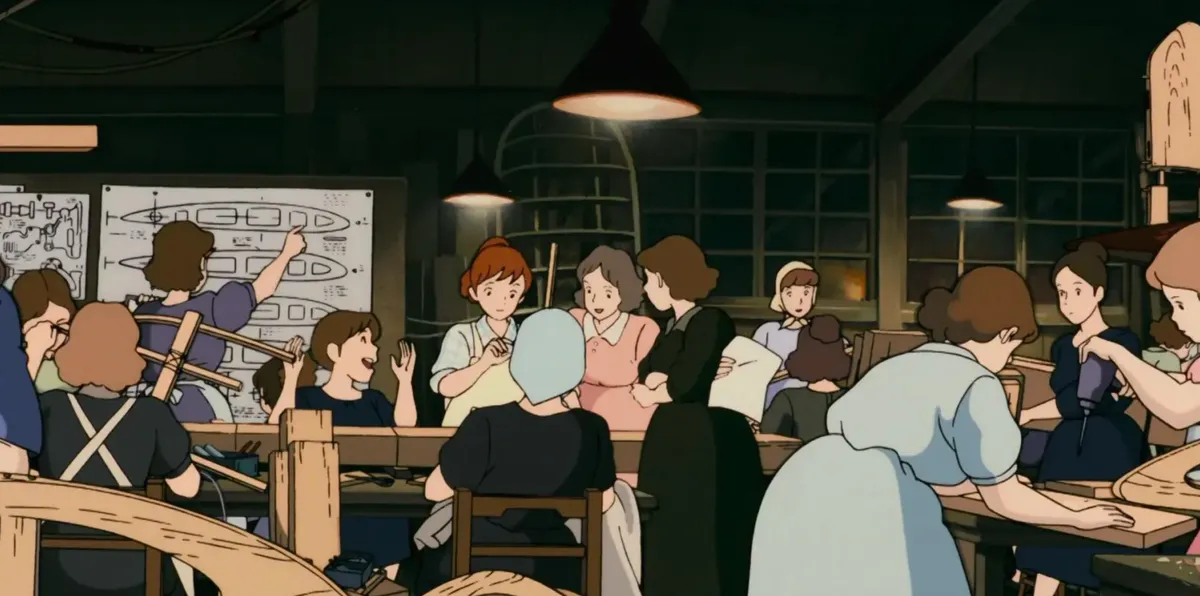
One of my least clearly articulated but nonetheless household-shorthand level concepts is "Ghibli gender." The seeds of this idea were planted when I finally watched Porco Rosso at the inappropriate age of 30 (the appropriate age is 40). When Porco needs to overhaul his iconic red airplane, he finds that the male workforce in his corner of Italy has mostly fled to seek other opportunities during the Great Depression. Instead, his workshop is taken over by Fio, a teenage girl and amateur engineer, and a hoard of her female relatives. The following scene is something special. Instead of showing a group of women adapting to a traditionally masculine space and activity, the garage becomes a feminine space. It's clear the women are more than competent, industriously accomplishing the work on the plane, but they also laugh, chat, and make a big spaghetti dinner for Porco, Fio's grandpa, and themselves.
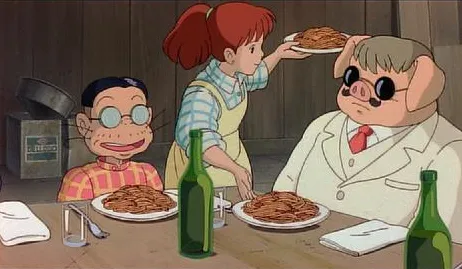
It's hard not to have the intrusive, brain-rotted thought of Porco Rosso getting longhoused knocking around, but in all seriousness when I watched this scene I got a vague, ill-formed sense that Miyazaki is some kind of gender complimentarian. It's nothing so simple as men and women each have their sphere and they should stick to it, but rather that he seems to have a reverence for a kind of feminine efficiency. The Italian women's culturally instilled, generations-honed skill for cooking and serving a big, raucous family is the skill that allowed them to take over the workshop. The scene makes it clear that Fio is not just a tomboyish heir to her grandfather's mechanical legacy, but that she gets her confidence and practicality equally from her female elders.
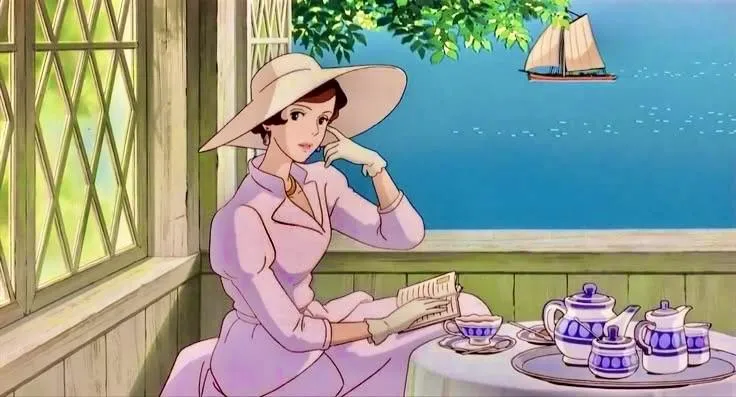
I wrote a post about how there is a Ghibli for all seasons a while back where I touched on Porco Rosso as the ultimate middle-aged man power fantasy. I stand by this assessment, and also my opinion that anything going on with Fio's crush on Porco isn't about sex or even romance, but the fantasy of being accepted; of an avatar of ultimate vitality - the pretty young woman - thinking you and your interests are cool. I never talked about Gina in that post. Madame Gina in a unique character in the Ghibli repertoire, at least by appearances. To be blunt, I think Miyazaki favors plainer women. There are plenty of beautiful Ghibli characters, but they are mostly down-to-earth mothers, women at work, or other such types that don't foreground their own charms. Gina's flamboyant beauty and glamour stick out.
Gina is as kindhearted and brave as she is beautiful. An old friend of Porco, Gina is a former pilot herself and multiple-times-over widow. She and Porco are the only living members of an informal flying club. If Fio has a girlish crush on Porco, Gina has an abiding love for him. She is the only major character who knew him as the human Marco. Like Fio, she has an eccentric and independent life for a woman. As a singer and the proprietress of the Hotel Adriano, Gina provides a hub for pilots, pirates, and other nomads. A place like this would not survive without the charisma and deft social balancing on Gina's masterful level. She is a strong, self-sufficient woman, but that indepedence is maintained in no small part with explicitly feminine qualities.
The women in Porco Rosso almost seem like landing beacons for its haunted protagonist. A place to land can be soft and welcoming, but it can also be a lifesaving solution that requires effort and skill to provide. Fio and Gina both ground Porco - Gina as the physical and emotional keeper of his humanity and through line in his history with flight, and Fio as a keeper of the inspiration and promise of continued flight, of the chance at a new adventure. Beyond the most basic visual cues, they are not positioned as a dichotomy. They are two unusual women using their virtues of creativity and diligence to enrich themselves and others.
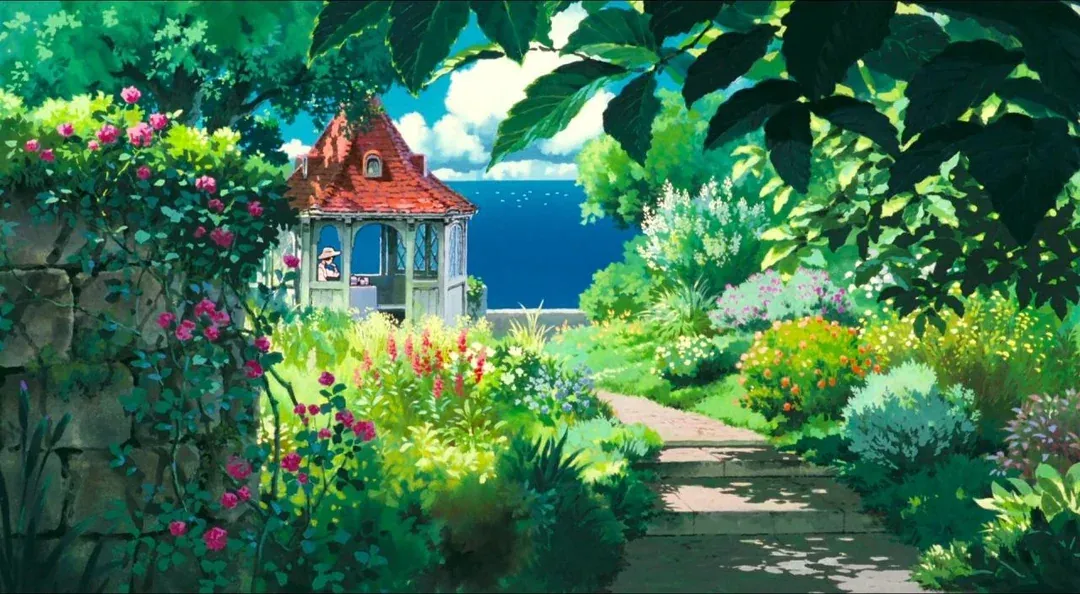
Although we never see Porco returned to his human form or get explicit confirmation that he accepted the grace and forgiveness of others enough to return Gina's love, it seems like they probably ended up together! A shot at the end of the movie shows Porco's red seaplane docked next to the garden where Gina has always waited - this time in the daylight. Whether that means Porco is human or that he is no longer ashamed to appear as a pig to Gina, it doesn't matter. A lesser story with a lesser woman would make the lack of transformation scene a glaring disappointment. The sheer force of Gina's steadfast belief in the man she has always known Porco to be does the trick of completing the transformation with or without physical evidence.
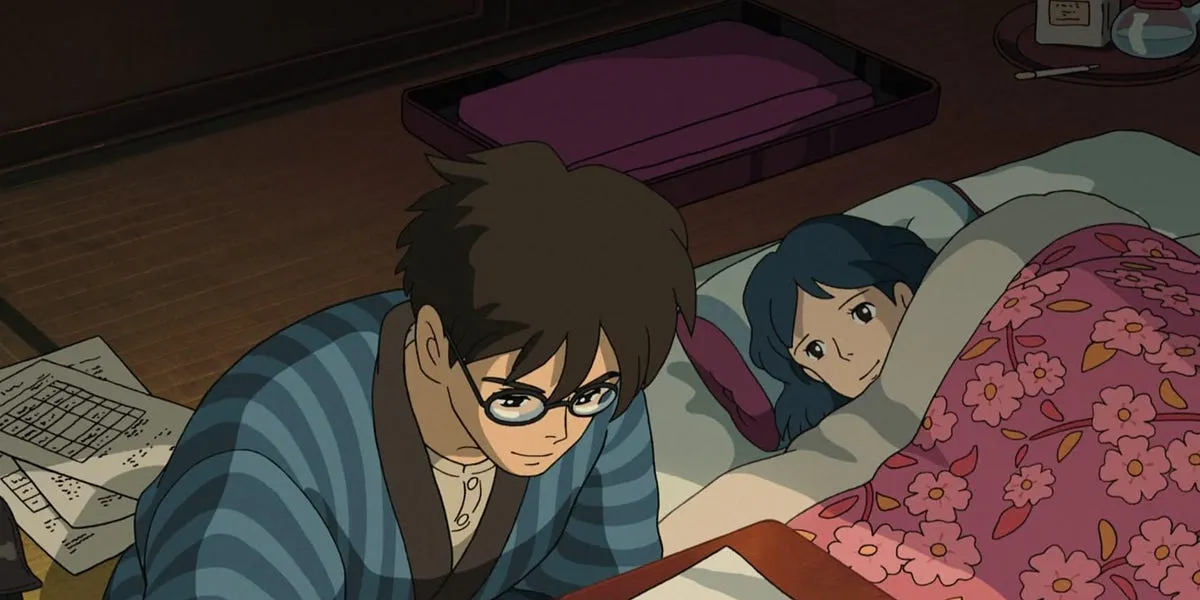 ᵗʰᵉ ᵈᵃᵈ ᶦⁿ ᵀᵒᵗᵒʳᵒ ʷᵃˡᵏᵉᵈ ˢᵒ ᴶᶦʳᵒ ᴴᵒʳᶦᵏᵒˢʰᶦ ᶜᵒᵘˡᵈ ʳᵘⁿ
The Wind Rises is almost impossible to consider apart from Porco Rosso, as the two fullest expressions of Miyazaki's complicated fascination with aviation. Despite being set in fascist Italy, the world of Porco Rosso is kinder to the romance of flight. The characters, whether pilot or engineer, have more room to live out their passions. The Wind Rises, however, is more a tale of thwarted genius, a story of resignation. As a young boy Jiro Horikoshi dreams of designing aircraft - literally, he has vivid dreams of Italian aeronautical engineer Giovanni Battista Caproni flying ornate passenger planes. The real Caproni never successfully built a commercial airliner and in fact caused a few fatal disasters. Like Horikoshi, he would find his only success in building military planes. Although at the time The Wind Rises was criticized for its positive portrayal of the man who designed the Japanese fighter plane used by kamikaze pilots, I saw it as a lesson about how the purity of creative vision will always be constrained by one's time in history. The Horikoshi of the movie is not a bellicose imperialist or a Nazi sympathizer, but a brilliant engineer who innovated in the only sector available to him.
So much of the conversational space around the film is taken up by these masculine, Wikipedia trawler concerns that you almost forget it's a love story. In a different way from Porco Rosso, I find the exertion of the female will and competency of feminine roles beautiful and fascinating in The Wind Rises. It's not just a loose biography of real man Jiro Hirokoshi, it's a loose adaptation of Tastuo Hori's novel The Wind Has Risen. Miyazaki uses the plot of a love interest suffering from tuberculosis as well as Hori's modernist influences (the character of Castorp being a reference to Thomas Mann's The Magic Mountain).
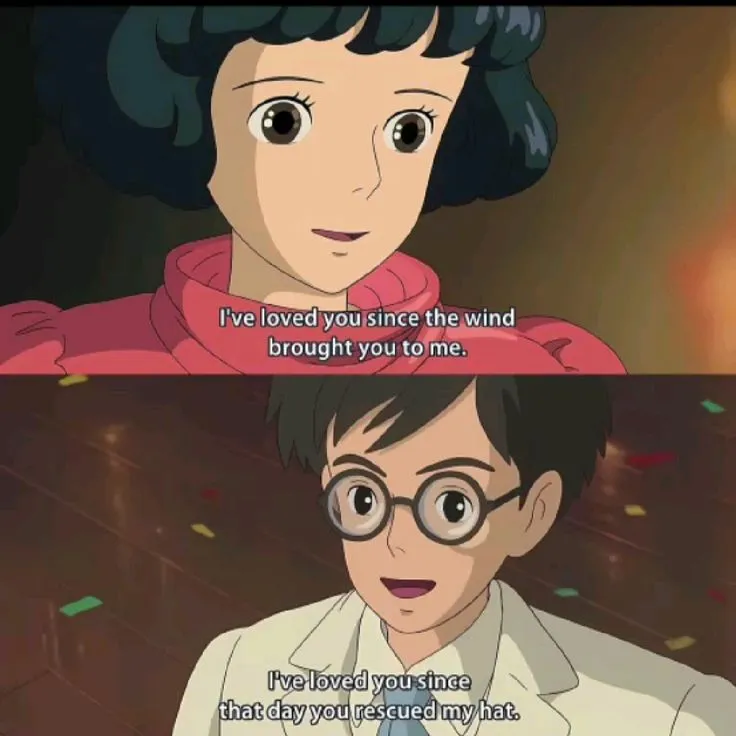
Jiro's romance with Nahoko, who he eventually marries, begins with disaster and fate. While travelling, Jiro catches Nahoko's hat as it nearly blows away on a train. They are kept together by the Great Kanto Earthquake, and Jiro helps Nahoko and her maid find Nahoko's family. Years later, they meet again at a mountain retreat, though Nahoko has been looking for him her entire adult life. She also admits that she has tuberculosis and doesn't know when she'll be well enough to marry. The couple is separated by Nahoko's stints in a sanatorium, but she leaves when she can no longer bear to be apart from her fiance.
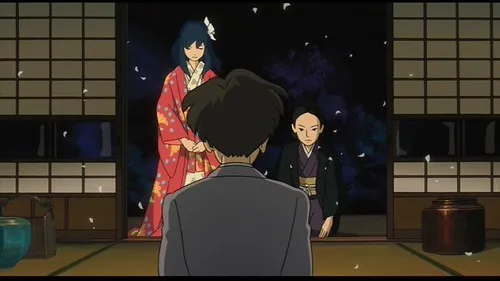
Jiro is staying at the home of his boss, Kurokawa, hiding from accusations of associating with anti-Nazi propagandists, and it is here that the couple seek shelter together. Kurokawa will not accept an unmarried couple living in his home, so Jiro proposes they get married immediately. Kurokawa balks, but his wife steps in to facilitate the ceremony. Without her radical support and enthusiasm, the wedding may not have taken place as soon as it did. Mrs. Kurokawa also takes it upon herself to prepare the bride. Kurokawa tries to dissuade Jiro, realizing how poor Nahoko's health is, but Jiro says that if he sends Nahoko back, he will give up his work on the fighter plane to be with her. Throughout the film, Jiro's devotion to Nahoko is deep and inspiring, but is quite responsive to her persistence and bravery. You get the sense of the women going out on a limb and the men rising to meet them. Mrs. Kurokawa acknowledges Nahoko's courage as she presents her to be married: “Hear me! I bring to you a lovely maiden who has come from the mountains to be with her beloved. She has given up everything for him. What say you?”
The epic romance of The Wind Rises cemented it as one of my favorite Ghibli films. I also find the quiet bravado of the women in it to be quite clever in the context of WWII. Nietzsche is a towering figure in the lineage of the modernism that influenced Tatsuo Hori. Thomas Mann was especially concerned with the relationship between sickness/decay and life/creativity in Nietzsche's life and work - a theme that runs through Nahoko and Jiro's story, as well as the biography of Hori himself. There is also, of course, the shadow of Nazi appropriation of Nietzsche's philosophy, particular the will to power. But it is Nahoko who exerts her will so strongly as to change her surroundings and circumstances in The Wind Rises. While the brilliant Jiro is constrained by coming of age in wartime, the triumph of the human spirit is expressed in the film's love story.
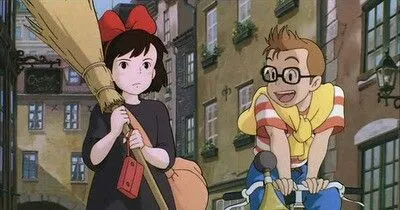
But what about one of the non sad adult man movies? What immediately came to my mind was Tombo and Kiki in Kiki's Delivery Service. Kiki doesn't have a romance, exactly. Tombo is a friend with a crush on her. He helps and encourages Kiki in her struggle to establish herself as a witch and the crisis of confidence that ensues, but no more than other characters like Kiki's boss, Jiji the cat, or a quirky artist Kiki meets in the woods. What I think comes across in Tombo's character and his relationship to Kiki is how girls and women are overwhelming to boys and men, awe-inspiring and magical even in they aren't literal witches. When a sort of pushy Tombo meets Kiki, he doesn't leave a good impression. She brushes him off, but in the face of her snub he simply says "what a cool witch!"
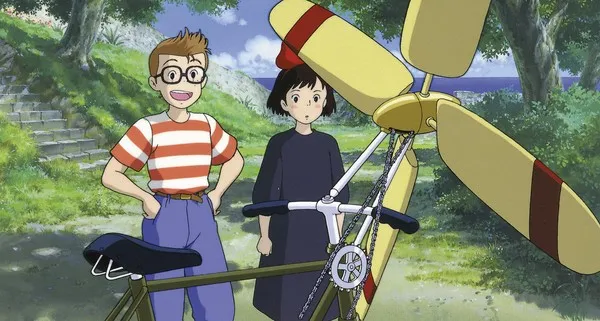
Tombo is, like every male character above, an aviation fanatic. He can peddle as fast as he can on his bicycle, but he can never catch Kiki in flight. It reminds me of how my husband has described puberty bringing with it the feeling that girls were almost of some untouchable other species. When Tombo builds a propeller setup for his bike as part of a project to create a human-powered plane, Kiki makes them fly. They crash, but I imagine that brief airtime will stay with Tombo forever, like the thrill of a smile or brush of the hand from a pretty girl.
Ponyo is a film I had little interest in until having my own child. To be honest, I'm not attached to the Ghibli movies that came out when I was an adolescent. My favorites swing from before my time/my early childhood to my young adulthood. My toddler, however, loves Ponyo second only to Totoro. It turns out Ponyo is also a great way to convince your small child to eat ham.
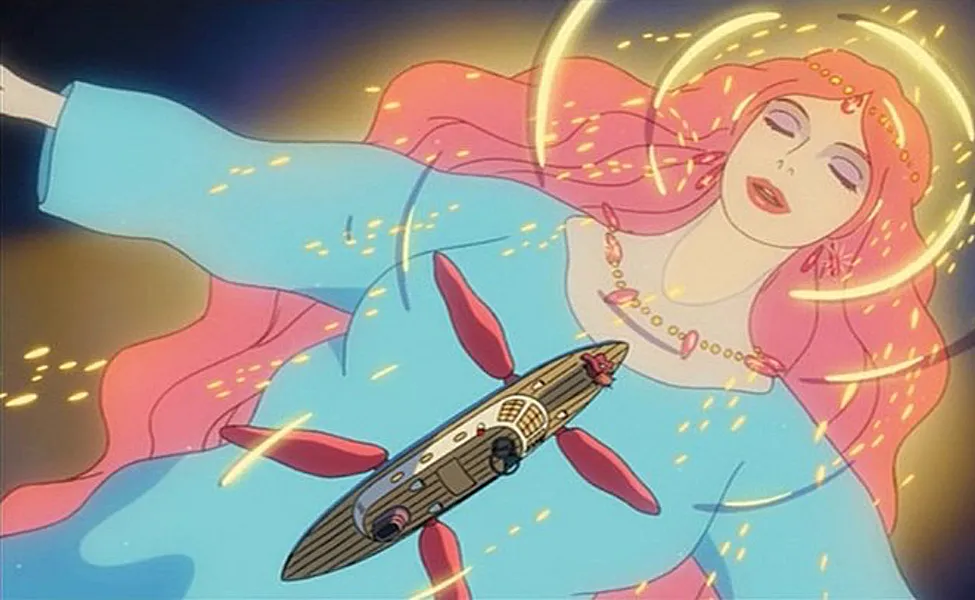
The story has a synthesis of the things I saw in Porco Rosso, The Wind Rises, and Kiki. Ponyo, the goldfish princess, has the terraforming love of Nahoko, but with a child's purity and in a fairy tale setting. Her crush on the human boy Satoshi leads her not only to physically transform into a girl, but to change the weather, challenge her powerful sea wizard father, and generally suck everything around her into the orbit of her young love. Her father, Fujimoto, for all his sorcery, is a giant paranoiac sad sack who is ruled by fear for most of the story. Ponyo's mother, Granmamare, is the radiant sea goddess. I see an exaggerated Kiki and Tombo sort of dynamic at play here. Even with Fujimoto's intelligence and aptitude for magic, he cannot compare to the sea: beautiful, life-giving and dangerous in turn, unfathomably large, and worshiped. This can be a kind of sexism, this idea that women are more mysterious and closer to the earth and the supernatural than men. It can be mostly harmless, but sometimes it can hint at an inability to try and understand women.
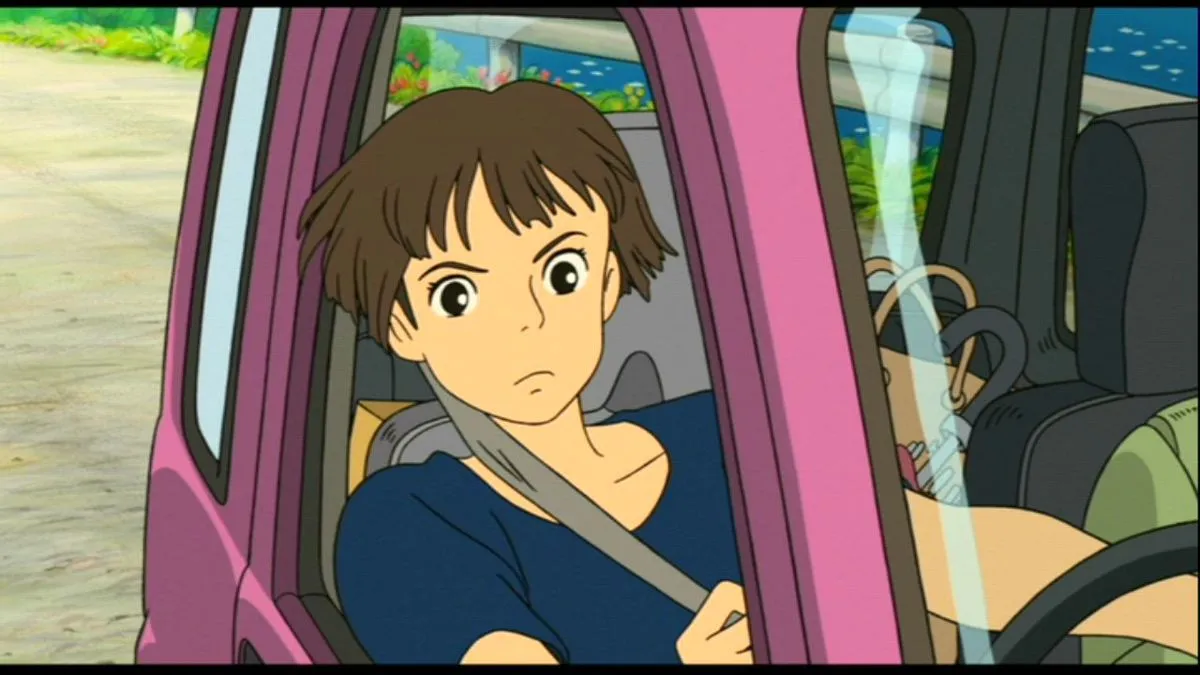
The most interesting character in Ponyo is Satoshi's mother, Lisa. She does not have the soft femininity of Kiki's mother, the light touch of Gina, and her iron will is not hidden behind girlish beauty and delicate manners like Nahoko. She is all sharp edges and urgency. She is also completely in line with Miyazaki's portrayals of women. If I could guess at the main idea behind her character, it's a sort of extreme domestic competency. On top of Lisa's job as at the local retirement home, she has to live like a single mother most of time, as her husband works on a large fishing boat. Her crazy driving, played for laughs at first but a critical skill later on, surely evolved from the stress of juggling her daily routine alone. Her professional life mirrors her home life, with parallels between wrangling children and keeping senior citizens cared for and relatively content. Her wise, nurturing mothering of Satoshi and Ponyo isn't at odds with her abrasive personality. Late in the film, she has a conversation with Granmamare about Ponyo's transformation, and it's clear they are speaking as peers in womanhood and motherhood, despite their very kiki/bouba character designs.
(also, I love that we are not party to the mothers' conversation...it's both touching in the story and to me sort of a touching admittance that it's just out of Miyazaki's sphere)
I don't have the energy to write about every movie, though surely there is something to be said for what the absence of an adult female presence does to the domestic balance in Totoro, or how Pazu and Sheeta from Castle in the Sky might be another example in the Kiki/Tombo mold. To put forth a possibly far fetched conclusion, I think Miyazaki's difficult personality and even misanthropy have accidentally created moving examples of men and women working together as compliments to each other. The female characters and roles they play in private and public life in Whisper of the Heart and Only Yesterday are more recognizably progressive and subversive in many ways - and those are incredible characters and films. It's hard to imagine Miyazaki directing Anne of Green Gables or Princess Kaguya and inhabiting those characters so fully for so much screen time. It's very possible that Takahata and Kondo understood or even straightforwardly liked women more. Miyazaki is definitely afraid women will laugh at him, but he also needs them.