Molly: The Sexiness of The Nutcracker
The other day I posted a Substack note about The Nutcracker:
I was thinking about a lot of things. The fumes of age gap relationship discourse have been perfuming the air lately, gaseous, escaping and expanding from whatever specific incident released them this time. Over the years people who don't know me very well, but know that I almost exclusively get involved with older men and also have the effrontery to engage in over-familiar teasing have made cracks about daddy issues. Whatever my damage is, I have a great relationship with my father and tend to not go for men who are either very similar or completely opposite of him.
If there is an incestuous association that must be slapped on my type, I would call it avuncular. Incidentally, I also have a good relationship with the one uncle I am close to, who is an extremely gentle and upstanding man on top of being TV handsome in a clean cut way which everyone knows is not my type. No, the idea of a real uncle is not appealing to me, but the men I like and the relationship dynamics that compel me in age gap fiction have a "dangerous uncle" quality to them. This man is your father's weird younger brother. Your father, in this fantasy, is the oldest child. Once upon a time, your wildcard uncle - younger enough than your dad to relate to you more but older enough than you to be scandalous - might have been shipped off to a monastery.
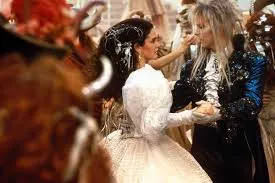
As I mentioned in my substack note, I've heard a lot over the years of Labyrinth being an early sexual awakening experience. Though David Bowie's Jareth is the goblin king and not Jennifer Connelly's dad's weird brother, I do think he fits the dangerous uncle mold. And Labyrinth is a great example of a coming-of-age story that honors what it's like to be a teenage girl. Sarah wants to grow up, and the strange, androgynous older man who is paying her special attention certainly gives her a taste of that, but the story returns power to her - to overcome Jareth and to choose her own path of maturity. The sexiness of the ball scene feels very true to me from what I can remember of being an adolescent girl, both scared and tempted by the adult world and the shadows I had yet to fill in.
To paraphrase Kaji in Evangelion, there as many ways to adapt The Nutcracker as there are people. Sometimes Marie is named Clara. Sometimes she remains a preteen for the entire story, and sometimes she is aged up in the fantasy realm. Sometimes Drosselmeyer isn't a sexy uncle so much as an odd, withered old man "uncle figure" (and sometimes he's a godfather) played with varying ratios of kindliness and light menace. George Balanchine representation in the televised version of his choreography was described as dancing the role "a very dotty old doctor, with glasses."I found a sweet article from 2012 in the Santa Fe New Mexican about a dancer, Steven Cook, and his feelings about the role: "Certainly there's darkness [in the character], but it's more complex than that. In the real-life part of the ballet, he's a lonely uncle who's trying to be liked."
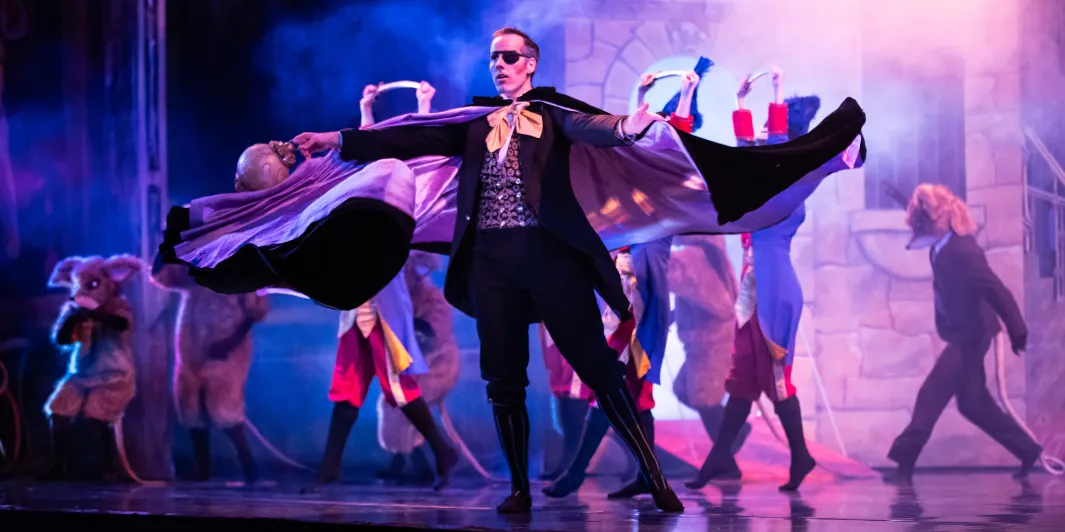
In the most recent version of my local company's ballet, they really leaned into the dashing uncle angle. A youthful 40-something Drosselmeyer sweeps into the party, turning heads and inciting a lot of intrasexual competition among the maids. This Clara stayed young for the fantasy sequence, where her uncle accompanies her and the prince as a guide, guarding her sleigh and waiting with a smile and nod of encouragement as she experiences these wonders. I found the characterization really interesting. At the party in Act I, he's not flirtatious or suggestive to his young niece, but she observes how other women see him, as well as watching her older sister (our ballet's star principle) courted by a young suitor. As the giver of the nutcracker and guide in the Land of Sweets, Drosselmeyer is sort of the psychopomp of Clara's fantasies - not explicitly sexual fantasies, but fantasies of romance and adult female beauty (the Sugarplum Fairy, Snowflake Queen, etc). It's easy to imagine an adult Clara thinking back to her uncle's Christmas appearances and realizing that his wildcard nature and the excitement it brought was a piece of the puzzle of her mature understanding of love, men, and desire.
What of Drosselmeyer's enchanted stand-in for a romantic partner? In most productions of The Nutcracker I've seen, once Clara is spirited away to the dream world, there is not a strong sense of chemistry or connection with the prince. He has become fully human and Clara is left to observe the intimacy of the pas de deux. But in Act I, the prince with the nutcracker head is truly her prince. It feels more tender, more like budding awareness of the opposite sex. What if my toy were a prince and a prince protected me?
The always excellent Megan Abbott captured the frisson of the nutcracker for young dancers in her novel The Turnout. I was like the boys yelling the basement meme when I learned Abbott was doing a ballet novel I'll tell you what. I've heard dancers complain that because of the obstacles boys face pursuing dance, boys in ballet companies are coddled and fussed over. This definitely shows up in The Turnout, but so does the unique vulnerability of the boys:
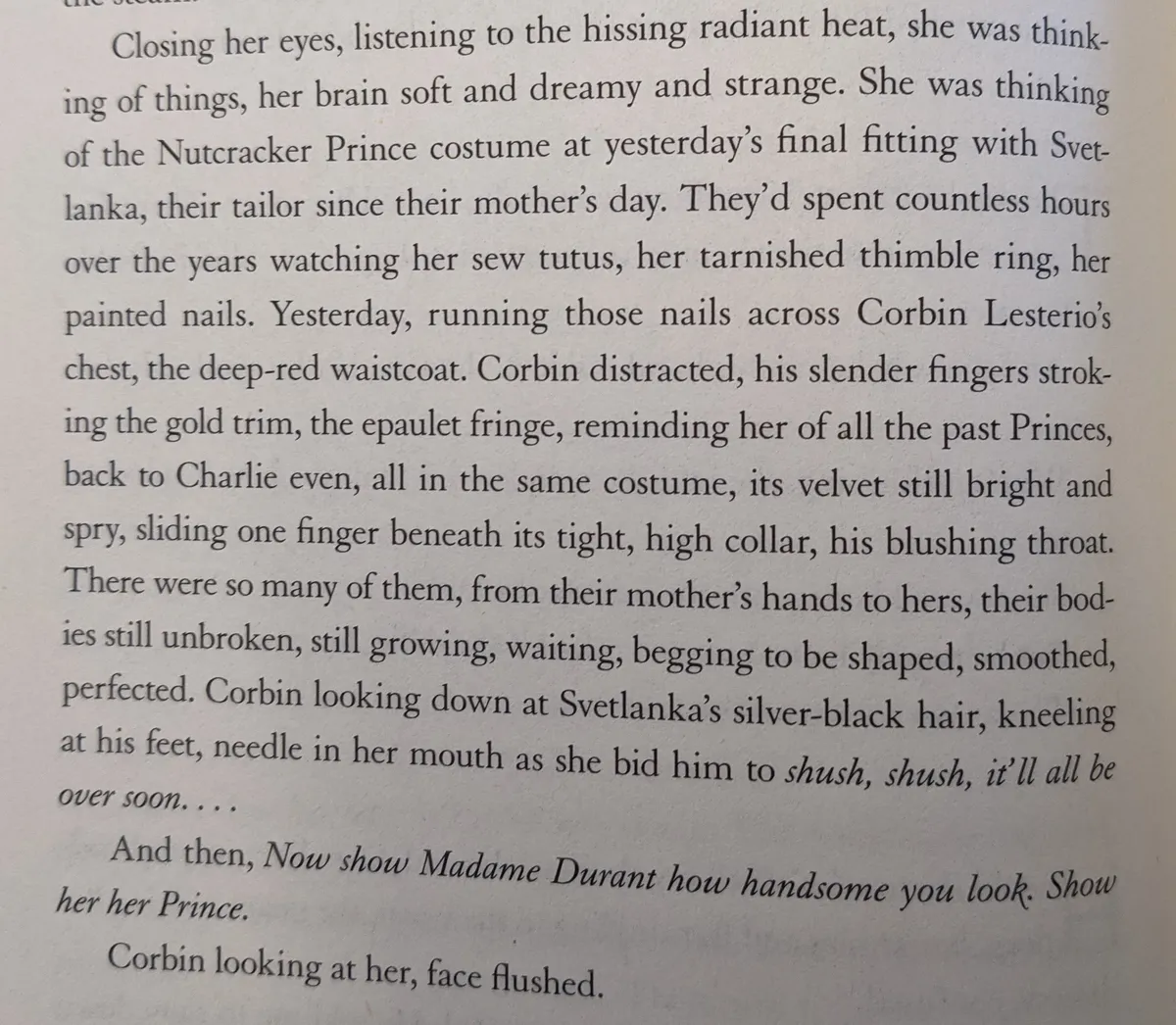
One of my favorite passages comes when the star male dancer tries on the nutcracker head for the first time:
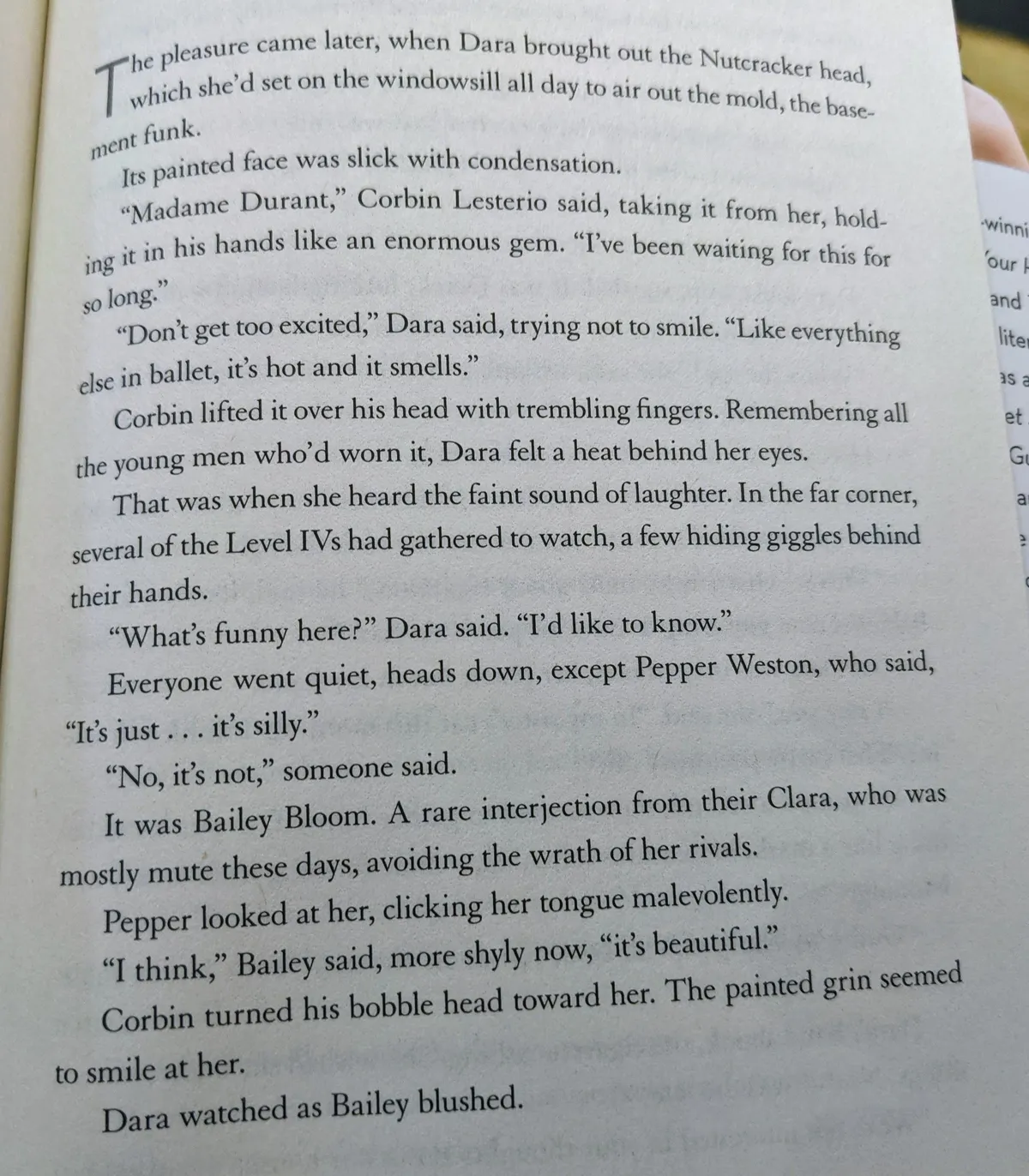
For the book's prince, it represents the moment he transform into his role. For its Clara, it's the moment she first sees him not just as her male classmate, but the boy who is going to be her prince. From the audience seats, it can be too easy to think of ballet as an almost inhumanly perfect sort of beauty and forget the bruised, sweaty, close-quarters reality of it.
The Nutcracker does not have a reputation for being a sexy ballet. It is the family friendly, some hater would say overrated, financial juggernaut of every ballet company from students to world class metropolitan troupes. I think the brilliance of its subtle shiver is that it doesn't undercut the family friendly, fairy dusted magic of it all. The enduring mystery of Drosselmeyer's character feels like an apt metaphor for the muddled years between childhood and later adolescence. The wholesome party full of candy, fun, and holiday joy feels the same every year until it doesn't. Your world is safe, and then a little welcome danger bursts in.